
What is adaptive roadmapping?
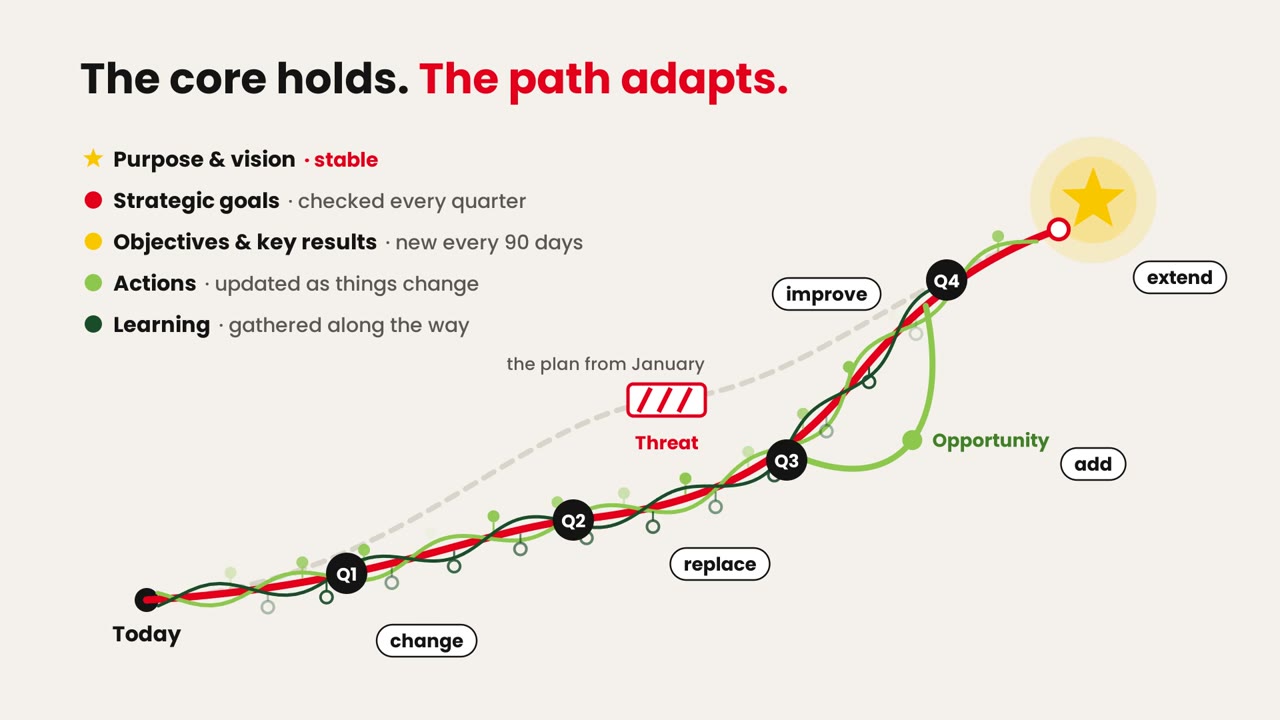
Adaptive roadmapping is strategy planning in short, repeated cycles. Purpose and vision stay. Goals, priorities and actions are checked every quarter and adapted to what has changed outside and inside.
A strategy that keeps moving. Without losing its way.
 1:46Watch: adaptive roadmapping in under two minutes
The yearly plan breaks by spring.
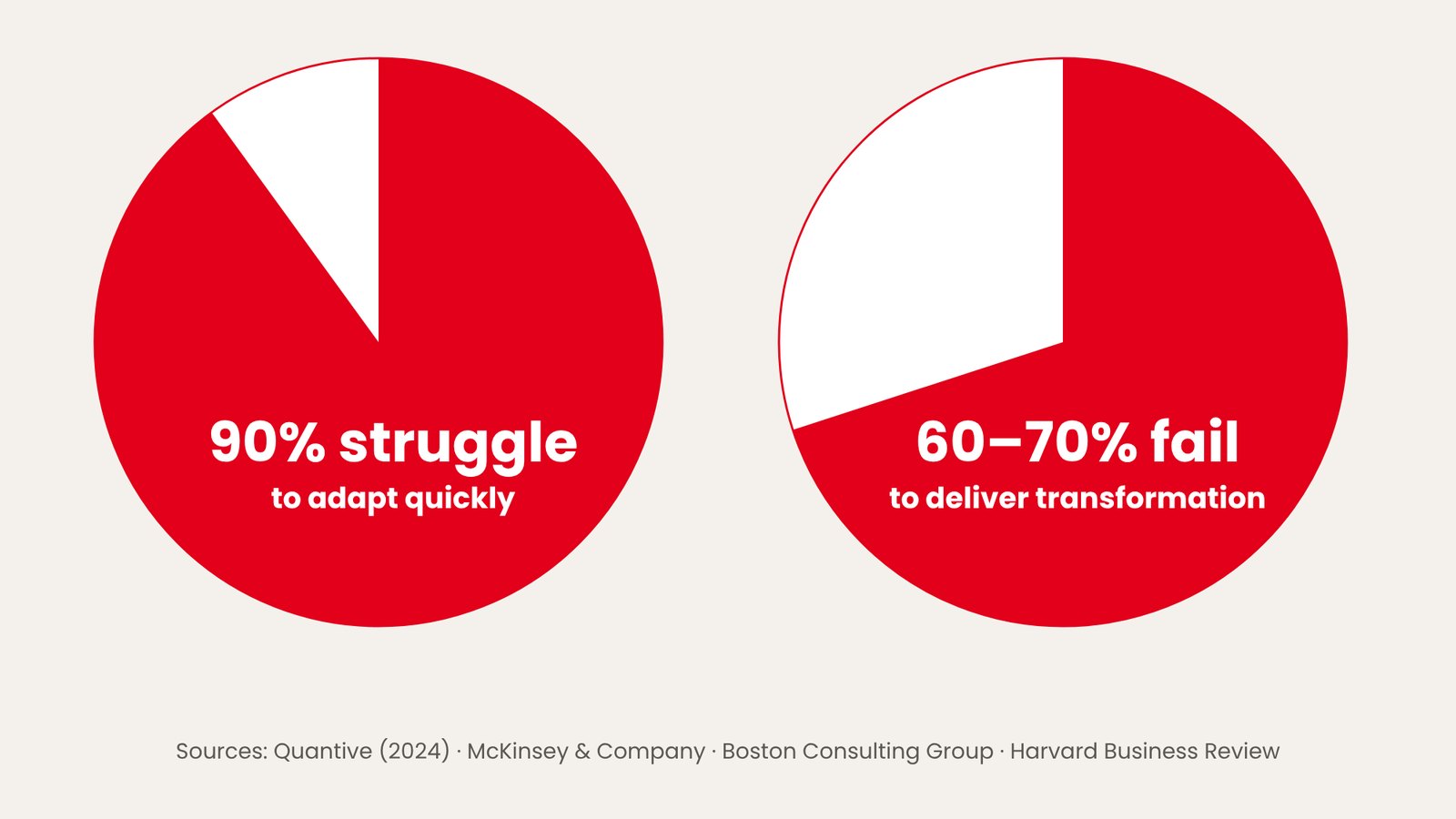
Most strategies are made once a year. Then the world moves on.
Markets shift, people leave, a competitor surprises. The plan stays in a drawer, and the team improvises. Adaptive roadmapping turns the plan into a rhythm. Not a new plan every week. One honest review every quarter.
The core holds. The path adapts.
Purpose or mission
Why you exist and what you do. Many teams use one of the two.
Vision
Where you want to go.
Strategic goals
One to three years. Adjusted when the world changes.
Objectives and key results
The next 90 days. Set anew each quarter.
Actions
Who does what, by when. Updated whenever something changes.
Static planning vs. adaptive roadmapping.
| Static planning | Adaptive roadmapping | |
|---|---|---|
| Rhythm | Once a year | Every quarter |
| Format | Thick documents | One visible page |
| Who plans | Management and experts | The team, together |
| What adapts | Nothing, until the plan breaks | Goals and actions. Purpose and vision stay. |
Not a product roadmap. Product teams use roadmaps for features. Technology foresight uses roadmaps for the next decades. Adaptive roadmapping works at the level of strategy: for a whole team or organization, for the next quarter, on one page.
Five steps, every quarter.
The Adaptive Roadmap Canvas™ (ARC) is a one-page tool for adaptive roadmapping. Every session follows the same five steps:
Mindset
Where do we stand? The 7-minute quick test.
TOWS table
Opportunities, threats, strengths, weaknesses.
Direction grid
One direction, goals and OKRs.
Action board
Next steps with owners and dates.
Learning loop
Keep, change or let go.
Step B is a TOWS matrix: outside first, then inside.
Download the free template (PDF) · Open in Miro · How ARC works →
Reebok, looking back.
Joe W. Foster, co-founder of Reebok, mapped two decisive moments of Reebok's history on ARC: from near-bankruptcy to survival, and the breakthrough into the U.S. market.
Reebok did not have a canvas back then. But it followed the same principles: look outside first, hold the purpose, adapt the path.
Read the case studies in the ARC Playbook → 1:30Joe W. Foster and Anthony B. Holtz in Berlin
Questions about adaptive roadmapping.
Is adaptive roadmapping the same as agile?
No, but they fit together. Agile works in sprints of a few weeks, mostly for products and projects. Adaptive roadmapping works at the level of strategy, in quarters. The quarterly direction feeds the sprints.
How often should we review the roadmap?
At least every quarter. Or whenever direction gets lost, or it all gets too much at once.
Who should take part?
The people who decide, and the people who carry it out. Strategy that a team builds together is strategy the team understands.
Do we need software?
No. One page is enough: paper, a whiteboard or a Miro board. The ARC template is free.
Try adaptive roadmapping on your own topic.
Start with one page. Keep it alive every quarter.
Book my free test drive30 minutes · with Anthony B. HoltzPrefer German? Kostenfreie Probefahrt buchen
ARC is the red beam through constant change.